
Qwen3 VL can be adapted to extract structured data from enterprise documents. For example, it can read a business registration certificate and return the company name, tax code, address, and legal representative needed to prepare a contract. Once extraction quality is stable, the next challenge is reducing response time without replacing the main model or weakening verification.
Why EAGLE 3
EAGLE 3 uses a smaller draft model to propose several next tokens, then lets Qwen3 VL verify them together. Accepted tokens reduce the number of expensive passes through the main model. Structured OCR is a good fit because field names, JSON format, and many value patterns are predictable. We fine tuned the draft component on the same document task to improve its token acceptance rate.
What changed in production
On the evaluated document workflow, inference became about 2.5 times faster while task accuracy remained nearly unchanged. The shorter response time reduces the wait between uploading a document and receiving structured fields for the next business step. The main Qwen3 VL model still verifies the proposed tokens, so acceleration does not depend on trusting the smaller draft model alone.
Reading P50, P90, and P99
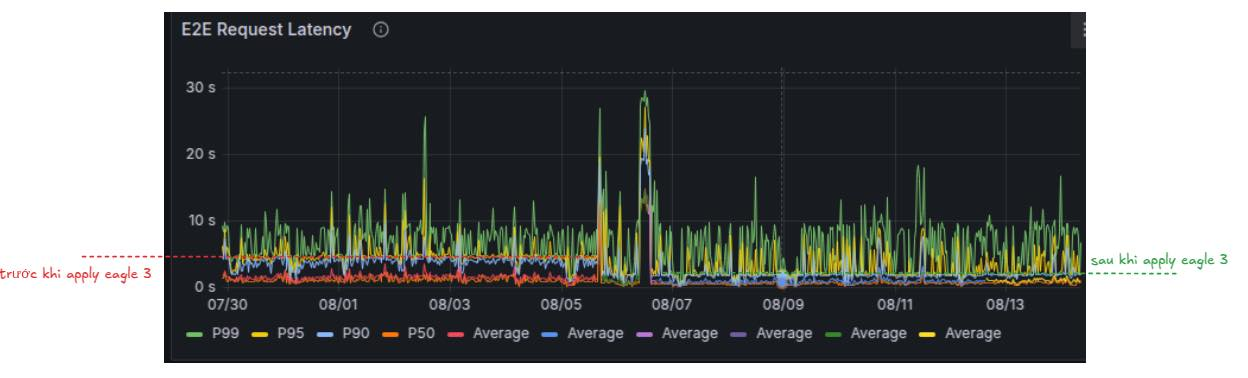
The Grafana chart shows lower P50 and P90 after EAGLE 3 was enabled. P50 represents a typical request, while P90 shows the latency experienced by most production requests. Their reduction confirms that the optimization benefits the normal workload rather than only a controlled benchmark.
P99 remained broadly unchanged. On difficult documents, the draft model sometimes proposes tokens that Qwen3 VL does not approve. Those candidates are rejected and decoding continues through the normal target model path. Accuracy is preserved, but these tail requests receive little or no speculative speedup.
The practical takeaway
EAGLE 3 is most valuable after the target model already solves the business task well. Fine tune Qwen3 VL for the document domain, establish a field level accuracy baseline, then train and monitor the draft model for acceptance rate. The exact speedup varies by hardware and output length, but the objective remains clear: shorten the real document workflow while keeping the target model in control of correctness.